Turn reactive maintenance into predictive action
An Anomaly Detection model continuously detects and predicts equipment degradation and emerging failures, and a GenAI Agent diagnoses root causes and recommends the right action, well before the issue escalates or failure occurs.
TWIN™
High vibration on DE bearing, 11.1 mm/s
Early inner-race wear from lubrication degradation
Schedule bearing maintenance within 36 hours
→ WORK ORDER CREATEDProtected · risk mitigated
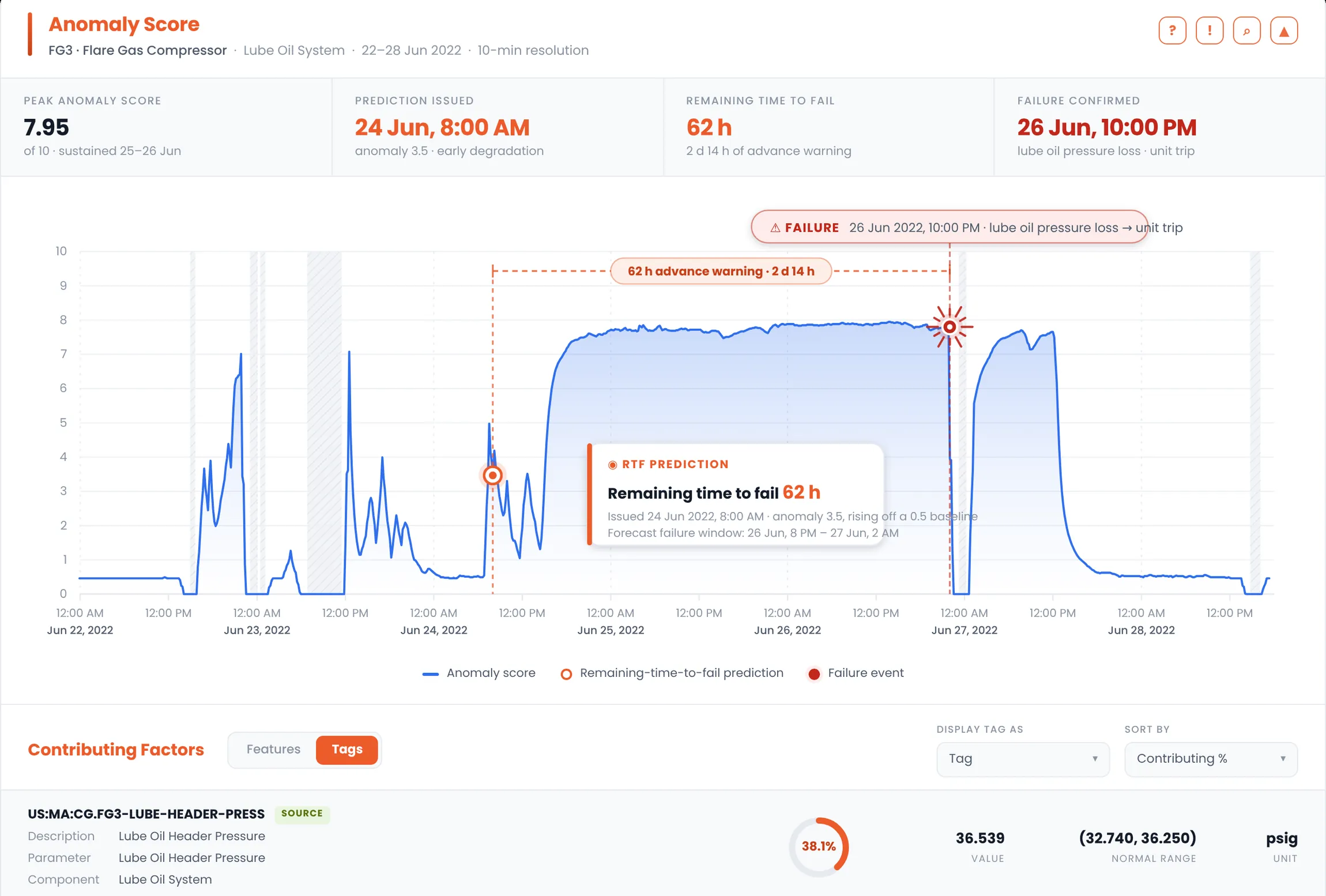
Anomaly Detection & Time to Failure
ML models trained on each asset's real operating history monitor live sensor data and flag genuine deviations early. Alongside every alert, the system forecasts remaining time to fail, up to two weeks ahead, so maintenance is planned in a window, not forced by a trip.
- Adaptive baselines per asset, load and ambient condition
- Catches process-driven issues upstream of the machine
- Remaining-time-to-fail forecast with every alert
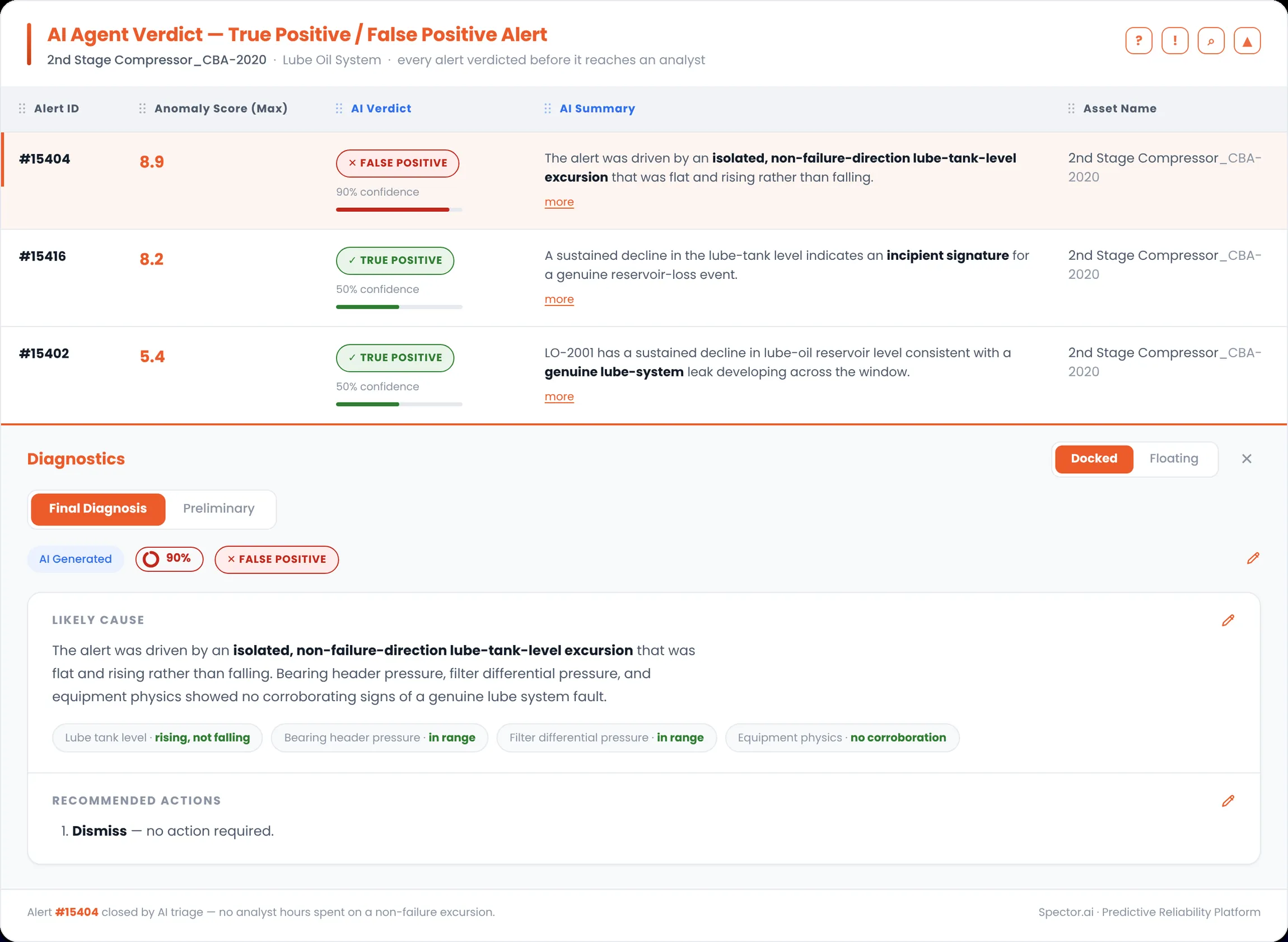
False Positive Assessment & Filtering
A dedicated False Positive Assessment agent validates every anomaly before it reaches your team, checking it against operating context, event history and known benign patterns. Engineers see only alerts worth acting on, instead of the 70% noise rate typical of conventional monitoring.
- Every anomaly validated before alerting
- Operating-context and event-history aware
- Feedback from engineers tunes filtering over time
Prognostics & Root Cause Analysis
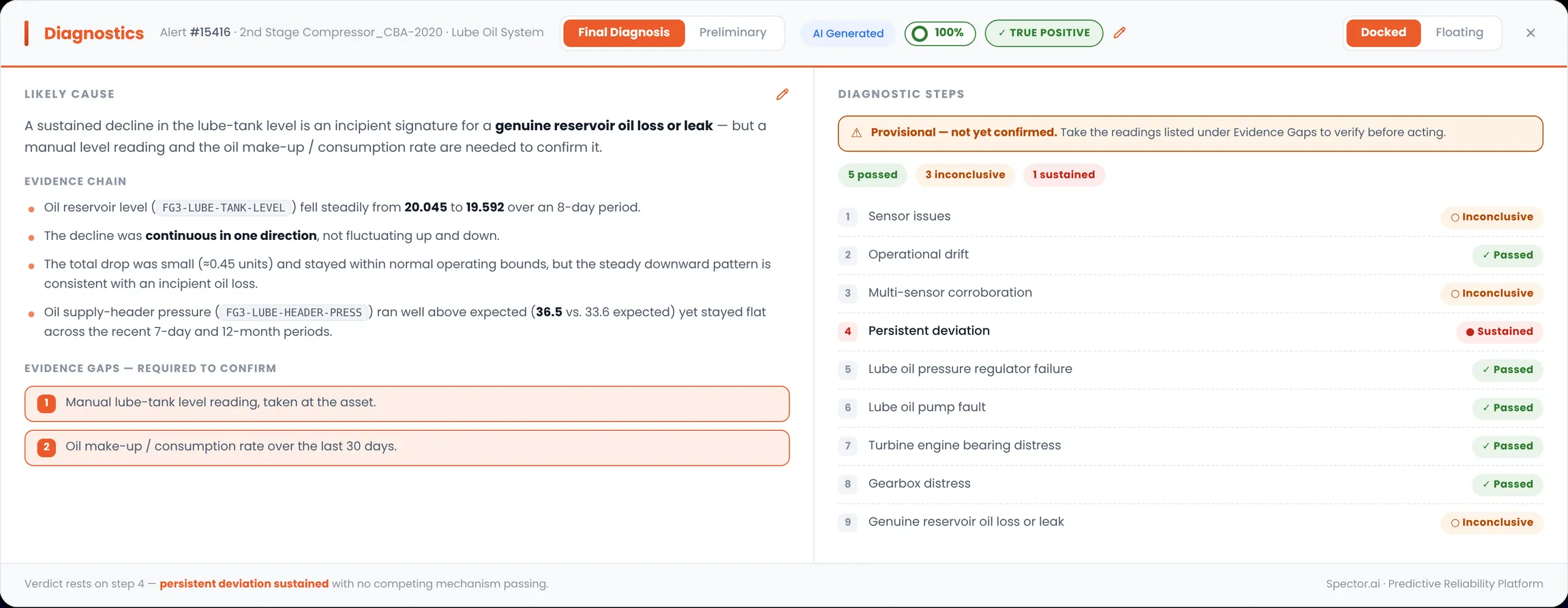
The GenAI Diagnostics Agent reasons over the Agentic Twin™ (FMEA records, failure ontology, manuals and plant history) to name the responsible failure mode and explain how it will progress. Every diagnosis is evidence-backed and reviewable by your engineers.
- FMEA-grounded failure mode identification
- Degradation reasoning with progression forecast
- Evidence trail your engineers can audit and correct
Actionable Recommendations
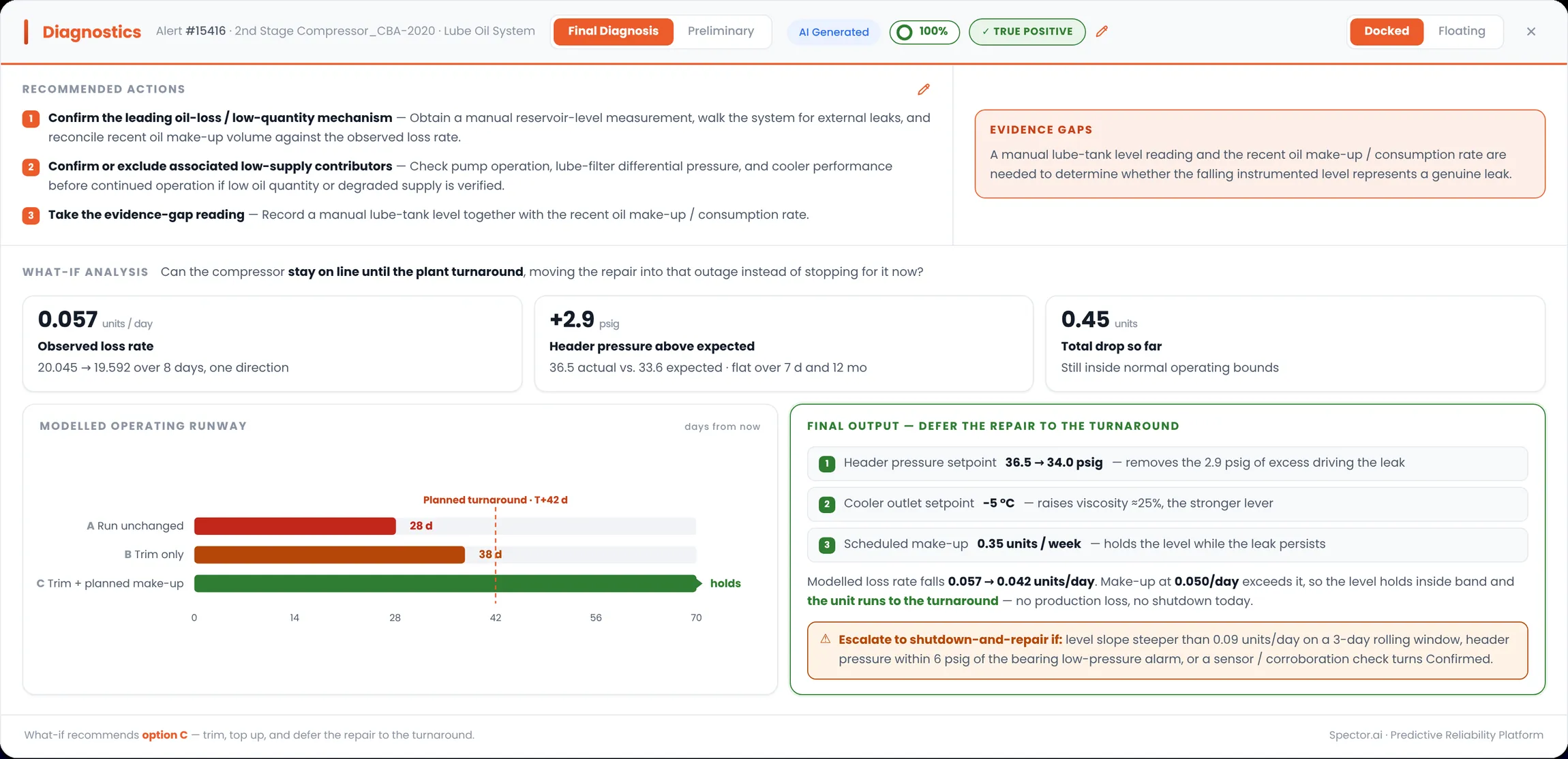
Every diagnosis arrives with the action to take: the maintenance plan that addresses the failure mode, the operational change that slows degradation, and what-if analysis to extend the operating window when a shutdown has to wait.
- Maintenance or operational action, ranked by impact
- What-if analysis to extend the operating window
- Expected effect and supporting evidence with every call
Work Management & Maintenance Planning
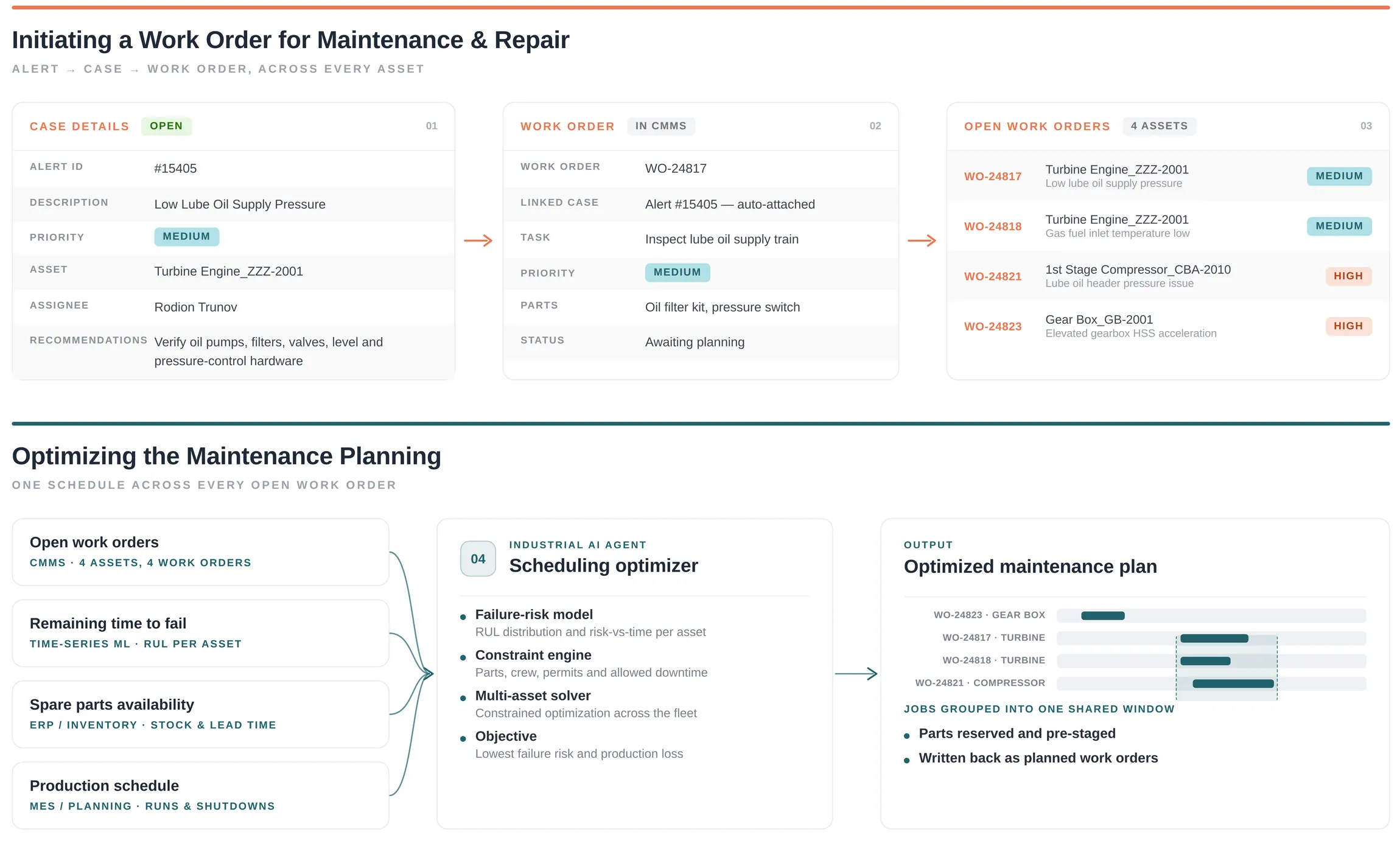
The recommendation becomes scheduled work. A case is opened with the full diagnostic context attached, a work order is initiated in your CMMS, and the maintenance window is planned against remaining time to fail, parts availability and production schedule.
- Case and work order initiated in your CMMS
- Maintenance window planned on remaining time to fail
- Closed-out work feeds back into the Twin for model training
Measured on real units.
Centrifugal Compressor Predictive Maintenance
Repeated gas-compression shutdowns, most of them unplanned, caused significant production losses, emergency maintenance, and reduced asset availability.
Equipment-specific anomaly and predictive models identify developing issues, including process-related causes upstream of the machine. GenAI-enabled failure-mode analysis, remaining-time-to-fail predictions, and what-if recommendations support proactive maintenance.
Up to $7.5M saved per avoided shutdown, with 100% asset availability targeted and shutdown costs of up to $210K per hour avoided.
Wind Turbine Reliability
Turbine faults give little warning, so failures became forced outages and lost generation. Mechanical, electrical and aerodynamic issues had to be detected days to weeks early, with root-cause explanations crews would trust and act on.
Anomaly detection on vibration and electrical signatures using autoencoder and LSTM-VAE models, a predictive model that estimates remaining time to failure days to weeks ahead, and a GenAI Diagnostics Agent that runs FMEA-based root cause analysis, names the failure mode and recommends the fix. Each diagnosis is captured in the Asset Knowledge Library for reuse across the fleet.
90% less downtime from unplanned turbine failures, longer equipment life, and lower labor and material costs.
Midstream Pumping Systems Reliability
Frequent trips across more than 100 critical product-transfer pumps caused unplanned downtime and emergency maintenance, with root causes often unclear.
Fleet-wide anomaly detection, predictive failure models, GenAI-based FMEA and root-cause diagnosis, remaining-time-to-fail prediction, and pre-emptive maintenance recommendations.
More than $320K downtime reduction per predicted failure, up to two weeks’ advance warning, and 42% lower mean time to repair.
Solar Power Inverter Reliability
Inverter faults and derating are usually caught after generation has already been lost, and across a large fleet it is hard to separate a failing unit from normal irradiance and temperature variation.
Anomaly detection on inverter electrical and thermal signatures, normalized for irradiance and ambient conditions, with time-to-threshold prediction and a GenAI Diagnostics Agent that runs FMEA-based root cause analysis and recommends the corrective action. Diagnoses are captured in the Asset Knowledge Library for reuse across the fleet.
Faults flagged up to two weeks ahead, fewer inverter trips and clipping losses, higher fleet availability, and planned rather than reactive interventions.